


Visit to the Krakow Salt Mines
The Krakow salt mines are best known as the Wieliczka Salt Mine. They are one of the most fascinating and evocative places in Poland, a true underground labyrinth carved by human hands over more than seven centuries. Entering this hidden world means venturing into a universe made of salt, silence and magic. Every corridor, every chamber and every bas-relief tells a fragment of Polish history and of the deep relationship between humankind and the earth.
The mine, with its descent, leads into a long wooden shaft, like an upside-down tower that gradually carries you into the depths of the ground. Step by step, the daylight fades and the smell of salt becomes more and more intense. It feels like an enveloping embrace. The air is clean and dry, and seems to bring instant relief. Many visitors feel they can breathe more freely. It is a therapeutic air.
Once you reach the lower levels, you find yourself immersed in an intricate network of tunnels and cavities. The miners who worked here, generation after generation, did not simply extract salt: they transformed the mine into a monumental work of art. Majestic caverns alternate with narrow corridors and decorated chambers, creating a landscape that seems dreamlike or even mythological.
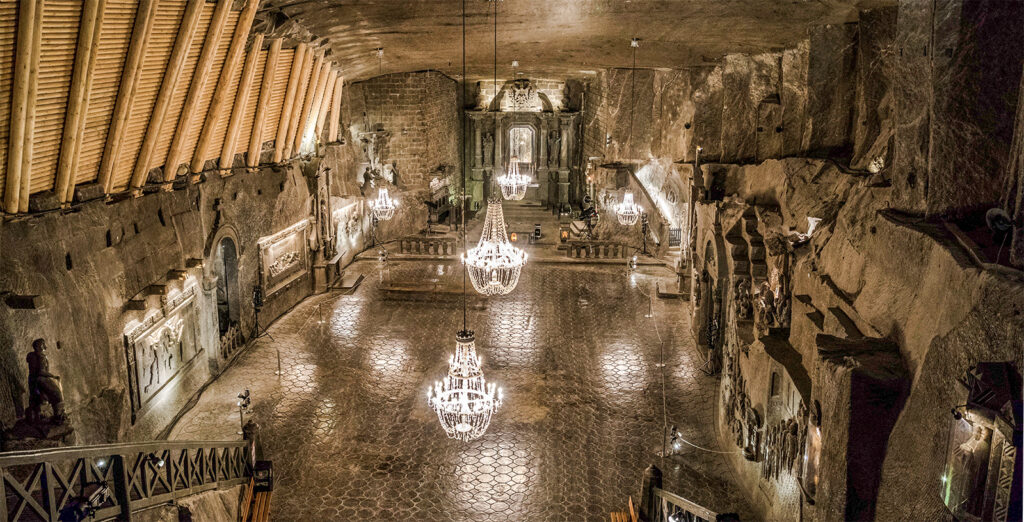
One of the first rooms is the Chapel of Saint Anthony, a space with sober, harmonious lines where the matte white of carved salt creates an almost mystical atmosphere. But it is only an introduction to the magnificent Chapel of Saint Kinga, the undisputed jewel of the mine. Entering it means finding yourself in an underground cathedral, entirely made of salt. The huge sculptures depict key scenes from the Bible, saints and bas-reliefs inspired by religious and historical events. Everything has been crafted with incredible precision, as if the salt were gentle marble in the hands of sculptors mad in their brilliance. The chandeliers, made with purified salt crystals, cast a warm light that gently fades over the surfaces, sending back reflections that give the hall an enchanted aura.
Besides the chapels, the mine is home to underground lakes of a deep green color. Soft spotlights enhance their stillness and shape. The water is dense due to the high concentration of dissolved salts, and seems almost solid. In some places, small wooden bridges allow visitors to lean out over the silent waters, giving the sensation of being suspended between two mountains. One is the earthly mountain on the surface, and the other is a mineral mountain that stretches still and eternal all around.
The corridors connect the different sections of the mine and represent a journey into the memory of the miners’ work. In the niches carved into the walls, you can find ancient tools, pulleys and examples of extraction techniques used in past centuries. Here, time seems to have stopped: it is easy to imagine the rhythm of daily work, the sound of pickaxes, the lives of the communities who spent entire days laboring in the bowels of the earth.
One of the most striking aspects is the vastness of the entire complex. Visitors are allowed to follow only a limited route, yet the mine stretches for kilometers and reaches depths of almost 300 meters. It is an almost infinite world made of salt that shimmers faintly under artificial light, composed of stairways that descend to levels where the silence almost breathes or can be touched, where small intimate spaces alternate with immense ones.
The constant climate, the purity of the air and the feeling of being in a place suspended between humanity and Mother Nature make a visit to the salt mine truly unique and unforgettable. This site was in fact among the first UNESCO World Heritage Sites: it embodies not only historical and technical value, but also an allure that speaks directly to the imagination. Visiting the mine means traveling through time and space, across centuries of human history and craftsmanship.
It is a world shaped from the simplest of materials, salt itself, which here becomes sculpture, architecture and spirituality. When you emerge into the open air again, many visitors feel a sense of detachment, as if they were already nostalgic for that mysterious and sacred place. A hidden kingdom in the depths of the earth that continues to live on in the mineral silence of its halls.
What to See at the Krakow Salt Mines
Visiting the Krakow Salt Mines is like entering an underground universe where history, art and nature walk arm in arm, creating a dimension that is truly one of a kind. The mine is located just a few kilometres from Krakow and is known as the Wieliczka Salt Mine. It welcomes visitors with an evocative route that unfolds through tunnels, galleries, underground lakes and spectacular salt sculptures. It is one of the most fascinating sites in Poland, a place where every chamber tells a fragment of life lived deep within the earth. Here are the most exciting highlights to see during a visit to this enigmatic location.
The Descent into the Wooden Shafts
The journey begins with the descent through a narrow wooden shaft, a sort of vertical tower that slowly leads towards the heart of the mine. It feels like a transition from the outside world to the one hidden beneath the surface. With every flight of stairs, the air changes: it becomes fresher and purer, lightly infused with the mineral scent of salt. A timeless place – perhaps this is the most fitting definition.
The First Underground Corridors
Once you reach the first level, you find yourself in a network of galleries carved directly into the salt rock. The walls, lit by soft lights, shine faintly, creating silvery or green-grey reflections. The underground corridors are wide and stable and along the route you encounter niches, small altars and statues carved by the miners themselves. These works are often religious in inspiration, serving not only as decoration but also as spiritual protection during the extremely hard underground work.
The Chapel of Saint Anthony
The first truly scenic room is the Chapel of Saint Anthony, a small underground church carved entirely out of salt. Statues, altars and decorations reflect the devotion of the miners and their artistic skill. The room has an intimate, secluded atmosphere. Everything is illuminated by soft lights that enhance the porous, matte surface of the worked salt.
The Gigantic Janowice Chamber
The tour continues to the Janowice Chamber, a vast cavity where carved scenes depict local legends, such as that of Princess Kinga. She is a figure associated with the origin of the mine according to Polish folklore. The tall, imposing statues emerge from the salt rock with remarkable precision. The space, wide and theatrical, feels like a page from an ancient tale transformed into tangible matter.
The Chapel of Saint Kinga – the Absolute Masterpiece
The mine’s most famous and astonishing point is the Chapel of Saint Kinga. It can truly be described as a monumental underground cathedral. Everything – absolutely everything – is made of salt. The hall is so large that it takes your breath away. A wide staircase descends towards a large central area, and before the visitor’s eyes appears a scene that seems sculpted from a single block of rock.
The sculptures portray key scenes from the Bible, saints and Christian symbols, all illuminated by warm lights that make the salt glow with a poetic soul, almost like translucent marble. It is a location of rare beauty, the spiritual heart of the entire mine.
The Underground Lakes
The underground lakes are another evocative feature, still, crystal-clear bodies of water hidden within the cavities of the mine. The dissolved salt makes the water particularly dense with intensely deep reflections. Small wooden bridges are perfect for admiring the rich colour of the water, which takes on an almost emerald hue under artificial light. These lakes create a silent, almost mystical atmosphere, like portals opening onto an unknown world.
The Miners’ Ancient Machines
Along the route you also encounter various reconstructions of the techniques and tools used to extract salt. There are pulleys, winches, lifting platforms and horse-driven machinery that bear witness to the daily efforts of the miners. These sections of the site offer an important historical perspective, showing how mining techniques and human ingenuity evolved over the centuries to tackle such a demanding job.
The Michalowice Chamber and Its Immense Spaces
Among the most impressive rooms is the Michalowice Chamber, formed by a huge wooden structure that supports the walls and ceiling. The space is so high and wide that it seems impossible to believe it was all dug by hand. The white wooden beams, lit by hanging lamps, create a truly unique architectural effect, almost like an industrial temple in the heart of the rock.
The Exit and Return to the Light
The visit ends with a ride in a special lift that quickly brings you back to the surface. After two hours spent in the depths of the earth, daylight seems almost dazzling. And yet the prevailing feeling is one of wonder: a blend of amazement, calm and gratitude for having discovered one of the most unique places in Europe.
Passes and Bundles
Useful info
Opening hours
Guided tours run daily year-round, but start times vary by date, season, and language. Check the mine’s official “Ticket prices & visiting hours” page the day before you go. Tours are guide-only.
Location
The main visitor entrance (Tourist Route, Daniłowicz Shaft) is at ul. Daniłowicza 10, 32-020 Wieliczka, about 10 km southeast of Kraków. The Miners’ Route uses the Regis Shaft at pl. Kościuszki 9.
How to get there
- Train: Take SKA1 from Kraków Główny to Wieliczka Rynek-Kopalnia; it’s a short walk to the Daniłowicz Shaft. Fast, cheap, and frequent.
- Bus: 304 from Dworzec Główny Zachód → Wieliczka Kopalnia Soli (for Daniłowicz) or Wieliczka Rynek (for Regis).
- Car: Easy access from the A4 (Kraków–Wieliczka junction); on-site parking areas are signposted.
Best time to visit
Book ahead, then aim for first tours of the day or late afternoon to dodge peak groups. Underground temps sit around 17–18 °C, so summer heatwaves aren’t a problem—bring a light layer year-round.
Duration of the visit
The classic Tourist Route takes ~2 hours; add the underground Saltworks Museum displays to stretch it to ~3 hours. (You’ll cover ~3 km, with ~800 steps overall.)
Accessibility
Parts of the Tourist Route are adapted for visitors with limited mobility; pre-book the dedicated accessibility tour slots (typically at the first/last opening hours). Assistance dogs are allowed. Note: there are many stairs on standard tours; strollers aren’t recommended.
Opening hours
Guided tours run daily year-round, but start times vary by date, season, and language. Check the mine’s official “Ticket prices & visiting hours” page the day before you go. Tours are guide-only.
Location
The main visitor entrance (Tourist Route, Daniłowicz Shaft) is at ul. Daniłowicza 10, 32-020 Wieliczka, about 10 km southeast of Kraków. The Miners’ Route uses the Regis Shaft at pl. Kościuszki 9.
How to get there
- Train: Take SKA1 from Kraków Główny to Wieliczka Rynek-Kopalnia; it’s a short walk to the Daniłowicz Shaft. Fast, cheap, and frequent.
- Bus: 304 from Dworzec Główny Zachód → Wieliczka Kopalnia Soli (for Daniłowicz) or Wieliczka Rynek (for Regis).
- Car: Easy access from the A4 (Kraków–Wieliczka junction); on-site parking areas are signposted.
Best time to visit
Book ahead, then aim for first tours of the day or late afternoon to dodge peak groups. Underground temps sit around 17–18 °C, so summer heatwaves aren’t a problem—bring a light layer year-round.
Duration of the visit
The classic Tourist Route takes ~2 hours; add the underground Saltworks Museum displays to stretch it to ~3 hours. (You’ll cover ~3 km, with ~800 steps overall.)
Accessibility
Parts of the Tourist Route are adapted for visitors with limited mobility; pre-book the dedicated accessibility tour slots (typically at the first/last opening hours). Assistance dogs are allowed. Note: there are many stairs on standard tours; strollers aren’t recommended.
Map of Wieliczka Salt Mine

